Where the Decision Stays Human
Data Analysis Scientists
Question real data, challenge competing AI recommendations, and simulate the future before making a call that has to stay human.
- Ages 10–15
- 8-Week Immersive Quest
- One Epic Mission per Week
The Big Idea
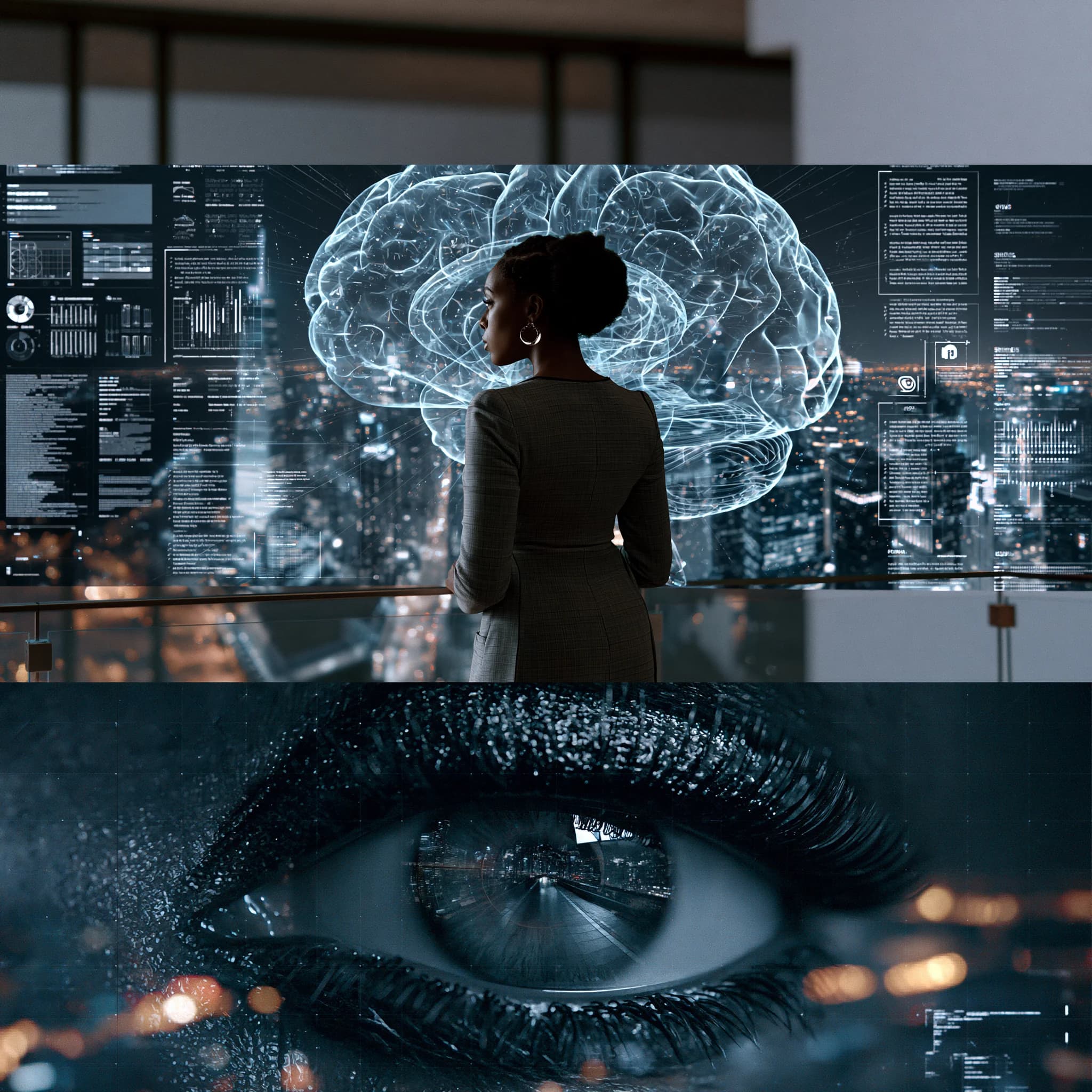
Data Analysis Scientists of 2050 puts 10-to-15-year-olds inside a crisis: a superstorm is 72 hours from the coast, three of the world's most powerful AI systems each recommend a different action, and the room turns to the E+ Kid and asks, “What should we do?” Built backward from a 2050 world where every system streams data every second, the course trains learners as the hybrid detectives of information who combine data, math, statistics, AI, systems thinking, and ethics. Machines are excellent at describing, diagnosing, and predicting; the Data Analysis Scientist lives at the human levels — finding real causes, weighing trade-offs, simulating futures, and making the final call without losing sight of the people affected by it.
What learners build
Every scientist runs the E+ 14-Step Data Intelligence Loop across the Quest — collecting and cleaning a real dataset, training a first tiny model, uncovering the hidden variable behind a suspicious correlation, then building and stress-testing a living digital twin of a city, microgrid, farm, factory, or lunar habitat.
The Showcase
The course closes with the 2050 Decision Intelligence Challenge: a 17-element evidence defense covering the data, the model, three future scenarios, failure cases, ethics, and a monitoring plan, answering the signature question “What evidence would make you change your decision?” before a permanent deposit into the learner's own Innovation Vault.
The 8-Week Roadmap
#1 Enter 2050: The World Is Data
Run a Data Safari across a 2050 city, mapping every system that produces data and asking which data actually matter.
Data Safari findings + 2050 Data Universe Map
#2 The Corrupted Data File
Hunt the planted errors in a corrupted city dataset before the city's AI acts on bad information.
Clean Dataset + Data Passport
#3 The Chart Courtroom
Put a technically-correct-but-misleading graph on trial and decide whether a chart can lie.
Courtroom verdict on a misleading chart
#4 Teach the Machine
Build Sprint 1 — train a first tiny AI model, then dig into the cases it gets wrong instead of celebrating the ones it gets right.
Working first model + error analysis of the missed cases
#5 The Causality Mystery
Investigate a suspicious correlation — does ice cream really cause sunburn? — to uncover the hidden variable that actually explains it.
Causal investigation report naming the hidden variable
#6 Digital Twin 2050
Build Sprint 2 — construct a living digital twin of a city, microgrid, farm, factory, or lunar habitat, then stress-test it.
Stress-tested digital twin simulation
#7 Can We Trust the AI?
Run the 10-point E+ AI Trust Audit on a model that's “94% accurate” to find out accurate for whom, and under what conditions.
Completed 10-point AI Trust Audit
#8 The 2050 Decision Room
Face three AIs with three different answers to a 2050 crisis and lead one of five teams to a humane, evidence-backed decision.
Evidence-backed crisis decision + Decision Challenge defense
Three Tiers, one Showcase
Explorer
Ages 10–11 · I Discover
A guided first orbit through 2050: fractions, percentages, charts, surveys, and basic AI, learning to tell a fact from a prediction.
Builder
Ages 12–13 · I Analyze and Build
More independence: Python basics, SQL, pandas, and visualization, cleaning real data and spotting correlation the way a working analyst does.
Innovator
Ages 14–15 · I Model, Test and Defend
The deepest track: algebra-level statistics, regression, classification, causal reasoning, and simulation, building and defending a full digital twin.
How learning works
See It
Learners examine a real example of the problem or technology before touching it themselves.
Simulate It
A guided, low-stakes walkthrough lets learners try the idea out before they build for real.
Build It
Learners create something real: code, a prototype, a design, a plan.
Explain It
Learners put what they built into words, defending their choices and their reasoning.
Own It
What they built goes into their Innovation Vault: their own intellectual property, kept and carried forward.
The Innovation Vault
Whenever a scientist gets stuck, Compass — the E+ AI Tutor — offers a Socratic ladder of question, nudge, direction, worked analogy, and explanation, but it never produces the answer itself; it only asks what evidence supports an idea, what assumption is being made, and what would prove the model wrong. Every capstone — model, digital twin, and 17-element defense — is deposited into the learner's own blockchain-anchored Innovation Vault, permanent intellectual property scored on a 25-point Creative Thinking Scorecard and marked with Spark Points and Creativity Passport stamps.
Safety, privacy & ethics
Every investigation runs Step 3 of the loop — Protect — before any modeling begins, and the final Decision Intelligence Challenge requires an explicit ethics-and-privacy accounting alongside the recommendation. Every number a scientist is given is labeled by its evidence rung — fact, projection, scenario, or speculation — and every frontier topic beyond 2050 is taught only as clearly labeled speculation, never as an established fact.